How to Choose the Right Multivitamin for Your Needs
Walk into any pharmacy or scroll through an online supplement store, and you'll be met with dozens of multivitamin options — different brands, formulas, price points, and bold claims on every label. Choosing the right one can feel overwhelming, especially when most packaging looks equally convincing.
The good news: picking the right multivitamin doesn't have to be complicated once you know what to actually look for. Here's a straightforward, step-by-step approach.
Step 1: Identify Your Specific Needs
Start with the basics — your age, gender, diet type, and lifestyle. A 25-year-old vegetarian woman with a desk job has very different nutritional gaps than a 45-year-old non-vegetarian man who trains regularly. If you've noticed signs like fatigue, hair fall, or frequent illness, that can also point toward specific nutrients worth prioritising.
Step 2: Check for Essential Nutrients
A solid multivitamin formula should generally cover the nutrients most commonly lacking in everyday diets — vitamin D, vitamin B12, iron, folate, zinc, and vitamin C. Rather than chasing formulas with an overwhelming list of exotic ingredients, look for one that reliably covers these fundamentals first.
Step 3: Vegetarian or Non-Vegetarian Formulation
This matters more than many people realise, especially in India. Some capsules use gelatin, which is animal-derived, even if the actual nutrients inside are plant-based. If you follow a vegetarian diet, check specifically for a vegetarian-certified formulation rather than assuming.
Step 4: Check for Certifications
Look for FSSAI approval as a baseline for any supplement sold in India — it confirms the product meets national food safety standards. Beyond that, indicators like lab testing and non-GMO sourcing are good signs of a brand that takes quality seriously rather than cutting corners.
Reading the Label: What the Numbers Actually Mean
Most supplement labels list each nutrient alongside a percentage, often shown as %RDA (Recommended Dietary Allowance) or %NRV (Nutrient Reference Value). This tells you how much of your daily requirement a single serving provides. A formula sitting around 50–100% RDA for most nutrients is generally reasonable for a daily multivitamin — numbers far beyond that aren't necessarily better, and in some cases exceeding recommended limits for certain nutrients isn't advisable without medical guidance.
It's also worth glancing at the ingredient list itself, not just the nutrient panel. A shorter, more recognisable ingredient list is often a better sign than one padded with additives you don't recognise.
Step 5: Consider Your Age and Life Stage
Nutritional needs shift over time. Iron needs are typically higher for menstruating women, while men and women both often need more support for bone health and energy as they move past their 30s. Choosing a formula designed for your gender and general life stage — rather than a generic one-size-fits-all option — tends to align better with what your body actually needs.
Step 6: Watch Out for Unnecessary Fillers and Additives
Some multivitamins are padded with artificial colours, unnecessary binders, or fillers that add little nutritional value. A simpler ingredient list isn't necessarily a downgrade — often it's a sign the brand is focused on the nutrients themselves rather than shelf appeal.
Step 7: Pack Size and Consistency
Since multivitamins work best when taken consistently, consider how committed you are before buying. A 30-capsule pack is a good way to trial a product for a month, while a 60-capsule pack suits those who already know a formula works for them and want to build a longer-term routine.
Common Mistakes When Choosing a Multivitamin
• Buying based on price alone — the cheapest option isn't always formulated with adequate nutrient levels
• Ignoring gender-specific formulation — men and women have meaningfully different nutrient needs
• Skipping the FSSAI check — always confirm the product is approved for sale in India
• Expecting instant results — multivitamins support long-term wellness, not overnight change
• Switching brands too often — constantly changing formulas makes it harder to build a consistent routine or notice how a product actually works for you over time
Quick Checklist Before You Buy
• Matches your gender and life stage
• Covers core nutrients — D, B12, iron, folate, zinc, C
• FSSAI approved and lab tested
• Vegetarian-certified, if that matters to you
• Reasonable %RDA levels, not excessive megadoses
• A pack size that matches how long you're willing to commit
Multivitamin For Her vs. For Him: Which One's Right for You?
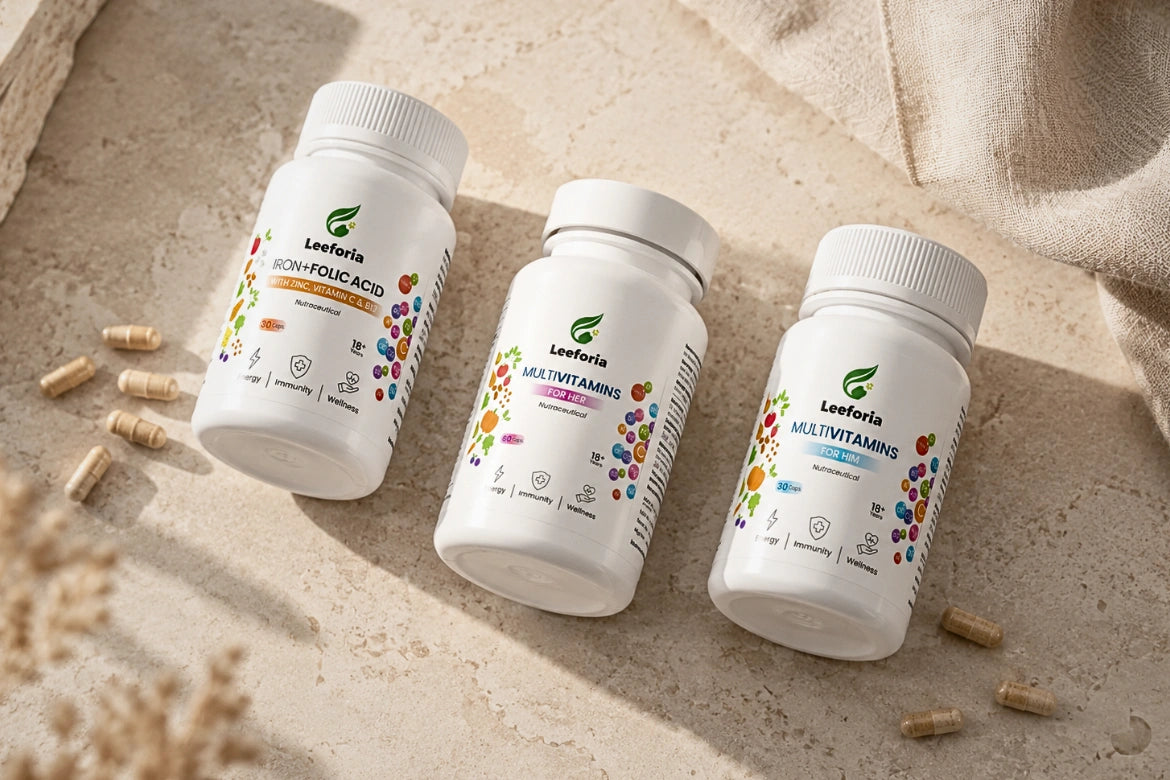
Leeforia's Multivitamin For Her is formulated around women's nutritional needs, including iron and folic acid support, while Multivitamin For Him is built around men's energy and immunity needs. Both are FSSAI approved, 100% vegetarian, non-GMO, and lab tested — so the main decision simply comes down to which is formulated for you.
Related reading: Signs of Vitamin Deficiency You Shouldn't Ignore · Best Time to Take Multivitamin Tablets: Morning or Night?
Frequently Asked Questions
Q: What should I look for first when choosing a multivitamin?
A: Start with your own needs — age, gender, diet, and any symptoms you've noticed — then check that the formula covers commonly lacking nutrients like vitamin D, B12, iron, and folate.
Q: Are expensive multivitamins always better?
A: Not necessarily. Price doesn't always correlate with quality. Focus on certifications like FSSAI approval and lab testing rather than price alone.
Q: Do men and women really need different multivitamins?
A: Yes, generally. Women typically need more iron and folate, especially during menstruating years, while men's formulas often focus more on energy and immunity support.
Q: How long before a multivitamin shows results?
A: Multivitamins support long-term nutritional balance rather than delivering immediate effects. Most people take several weeks of consistent use before noticing a difference.
Q: Is a vegetarian multivitamin less effective than a regular one?
A: No. A vegetarian formulation simply avoids animal-derived ingredients like gelatin in the capsule — it doesn't reduce the effectiveness of the actual nutrients inside.